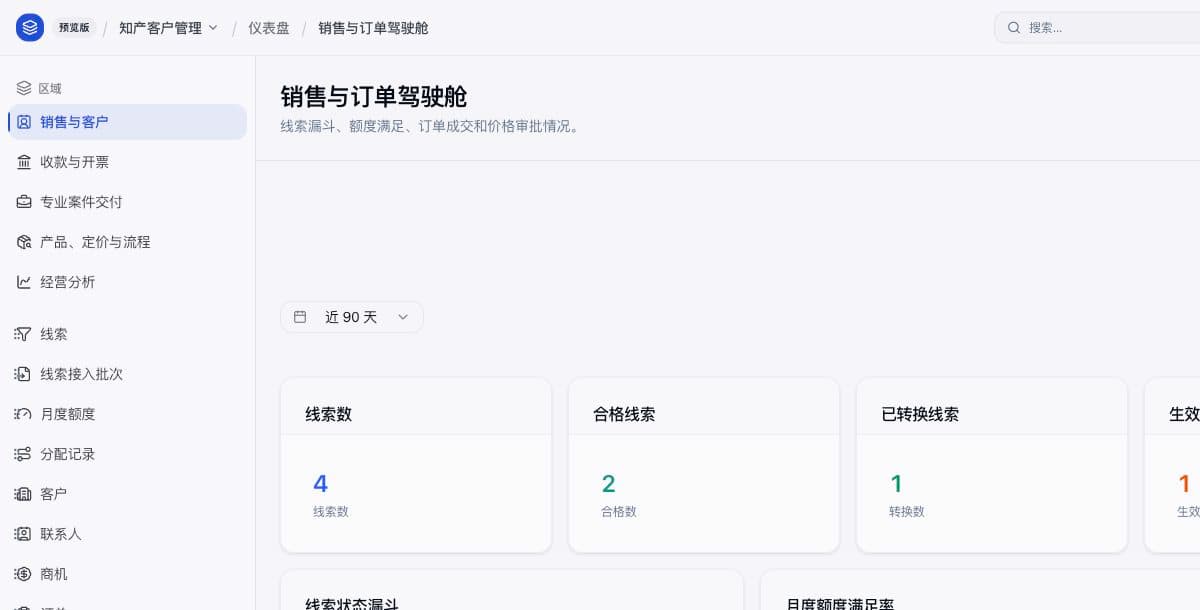
Sales and order cockpit
See lead volume, qualification, active orders, and quota fulfillment in one chain from acquisition activity to commercial outcome.
IP CRM serves trademark, patent, copyright, and rights-asset organizations. From lead quotas and order pricing to collections, invoicing, contracts, matters, statutory deadlines, and IP assets, every critical action retains business evidence.
Every image below comes from the current IP CRM runtime and is cropped to a publication-safe workspace area. Sales, finance, and specialist delivery share the same objects, permissions, and operating facts.
See lead volume, qualification, active orders, and quota fulfillment in one chain from acquisition activity to commercial outcome.
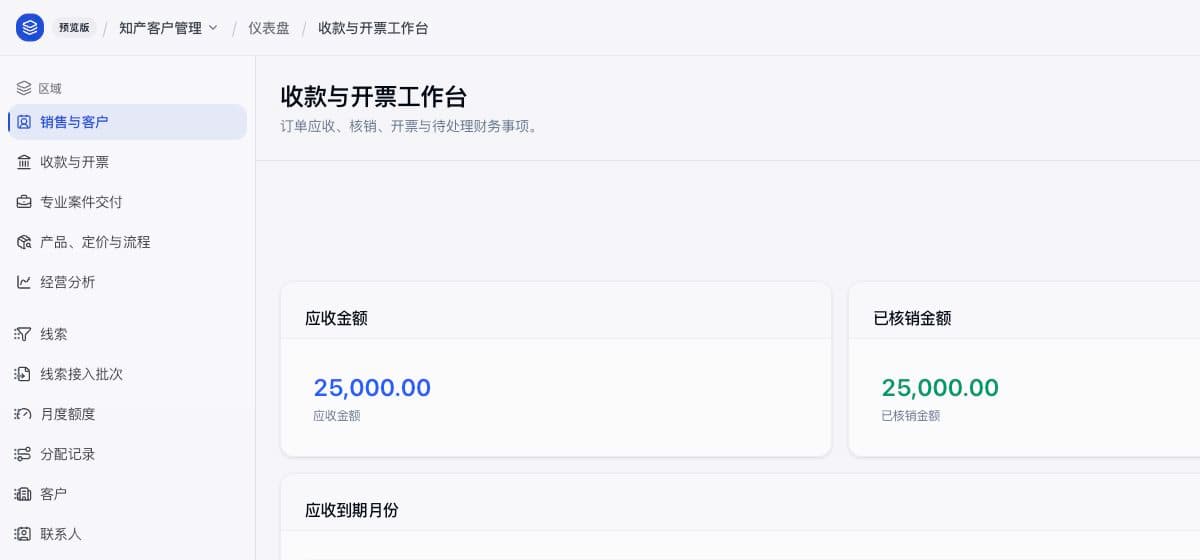
Bring receivables, allocation, outstanding balances, and invoice status into one finance view for faster exception handling.
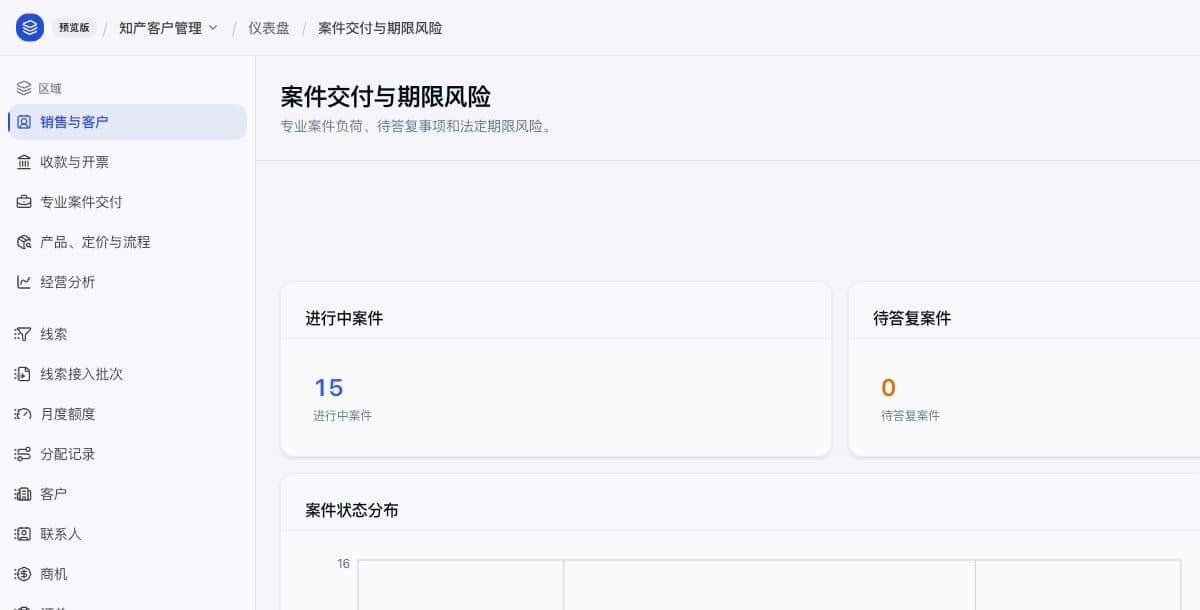
Track active matters, response obligations, specialist workload, and statutory deadline risk throughout professional delivery.
Sales, finance, legal, and matter delivery share the same order and customer facts instead of reinterpreting work across spreadsheets and disconnected tools.
Manual, channel-batch, and native CSV/XLSX intake with attribution, consent, and duplicate controls on every write.
Atomic conversion and orders that freeze product, official fee, service fee, cost, and delivery strategy.
Independent price and official-fee versions route discounts, low prices, and negative margin into governed outcomes.
Installment plans, offline review, signed callbacks, invoice capacity, and an independent contract lifecycle.
Create matters per order line or quantity, then run delivery templates, review, documents, costs, and statutory dates.
Promote trademarks, patents, and copyrights into assets with trade locks and idempotent renewal opportunities.
Critical calculations, approvals, and state changes have explicit inputs, legal boundaries, and idempotent evidence. The app does not infer tenant policy from model output.
Native import supports worksheet and column mapping, server preflight, background progress, and failed-row downloads while every write passes the same attribution and duplicate hook.
Allocation considers product line, business type, source, fulfillment, open load, daily limits, and leave—with deterministic evidence.
Submission freezes product, official fee, price, cost, delivery, and installment inputs; approvals map to immutable order revisions.
Signature, time window, and idempotency protect payment-center callbacks while channel-specific acquisition remains with the authorized payment center.
Templates, tasks, review, official documents, deadline changes, actual fees, and IP assets create an independent auditable delivery model.
Sales, finance, and delivery dashboards are paired with funnel, quota, margin, collection, workload, and deadline-risk reports.
IP CRM installs the ObjectStack REST, OpenAPI, and MCP connector providers. Trusted connections can drive defined operations without bypassing object permissions, approval, row-level security, or audit.